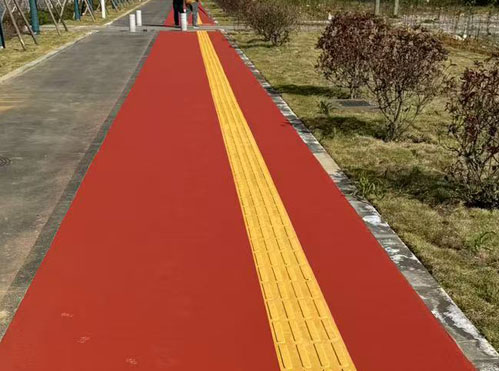
Traditional gray pavement has been the standard for decades, but modern cities are increasingly shifting toward colored pavement for both functional and visual reasons. While gray concrete or asphalt focuses mainly on structural performance, colored pavement adds an extra layer of safety, communication, and urban design value. The question is no longer whether pavement should be strong—but whether it should also be smart.
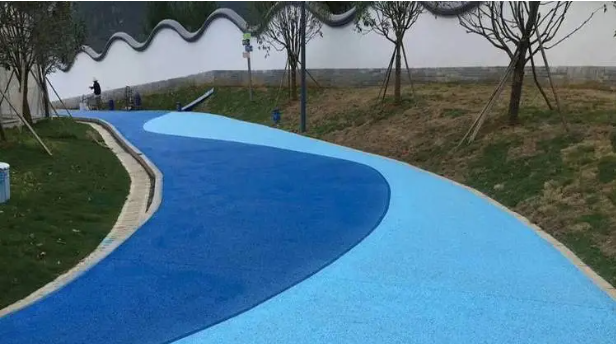
One of the strongest reasons to choose colored pavement is improved visibility.
Gray surfaces often blend into the environment, especially in low-light or rainy conditions. Colored pavement, on the other hand, stands out clearly and helps road users quickly recognize different zones.
For example:
Red highlights bicycle lanes or danger zones
Green indicates shared cycling or pedestrian routes
Bright surfaces mark crossings and conflict areas
This visual clarity reduces hesitation and improves reaction time, lowering the risk of accidents.
Colored pavement acts like a “visual language” for the road.
Instead of relying only on signs and painted lines, color itself becomes a guide for behavior.
It helps:
Separate vehicles, cyclists, and pedestrians
Define bus lanes and priority routes
Highlight school zones and safety areas
Organize complex intersections
Compared to gray pavement, which provides no built-in guidance, colored pavement actively improves traffic organization.
Gray pavement is functional but visually plain. Colored pavement transforms roads and public spaces into part of the urban design.
Cities use colored surfaces to:
Create identity in commercial districts
Improve tourism and scenic areas
Enhance parks and public plazas
Build modern cycling networks
This improves not only appearance but also how people experience the city.
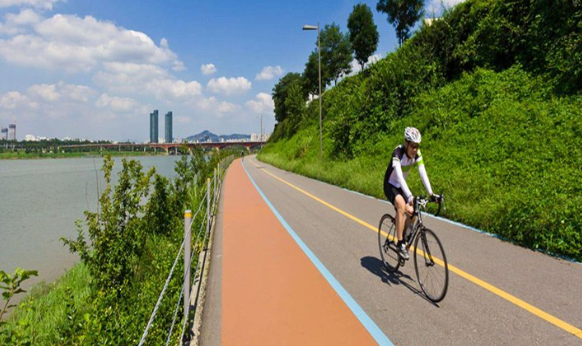
Colored pavement is especially effective in areas where accidents are more likely.
These include:
Intersections
Pedestrian crossings
School zones
Bus stops
Curves and ramps
Bright colors combined with high-friction surfaces improve driver awareness and reduce stopping distance, especially in wet conditions.
Unlike standard gray pavement, colored systems can be designed with anti-slip aggregates such as calcined bauxite or ceramic particles.
This provides:
Higher traction
Better braking performance
Safer performance in rain or snow conditions
This makes colored pavement a functional safety upgrade, not just a visual one.
Gray pavement relies heavily on painted markings, which fade over time and require frequent repainting.
Colored pavement reduces dependence on surface paint because:
Color is part of the surface layer
Guidance remains visible longer
Maintenance cycles are reduced
This improves long-term efficiency for municipalities.
Modern urban planning emphasizes smart infrastructure. Colored pavement supports this by:
Enhancing wayfinding for cyclists and pedestrians
Supporting multimodal transportation systems
Improving road user behavior through visual cues
Integrating with smart mobility planning
Gray pavement does not provide this level of functional communication.

Some colored pavement systems use light-toned or reflective pigments that reduce heat absorption compared to dark gray asphalt.
Benefits may include:
Lower surface temperature
Reduced urban heat island effect
Improved comfort for pedestrians and cyclists
This makes cities more livable in hot climates.
Color influences how people behave in traffic environments.
Colored pavement can:
Encourage drivers to slow down in marked zones
Make cyclists feel safer in dedicated lanes
Increase pedestrian awareness in shared spaces
Gray pavement lacks this behavioral influence.
Choosing colored pavement over gray is not just a design decision—it is a functional upgrade. While gray pavement remains cost-effective and structurally reliable, colored pavement delivers clear advantages in safety, traffic organization, visibility, and urban aesthetics.
In modern infrastructure planning, the best solution is often not choosing between gray and colored pavement, but using colored pavement strategically to enhance the most important areas of the road network.